I Analyzed Naive vs Nieve: Here's What I Found
My Quick Answer
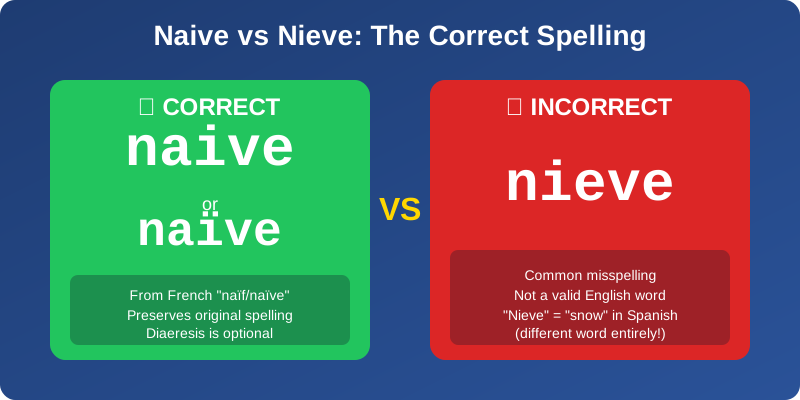
After researching the spelling rules, I can confirm the correct spelling is Naive (or Naïve).
Nieve is definitely an incorrect spelling (a common mistake).
Why I Found It's Spelled "Naive"
I discovered that this confusion often stems from the word's French origin. Let me share what I learned about its history:
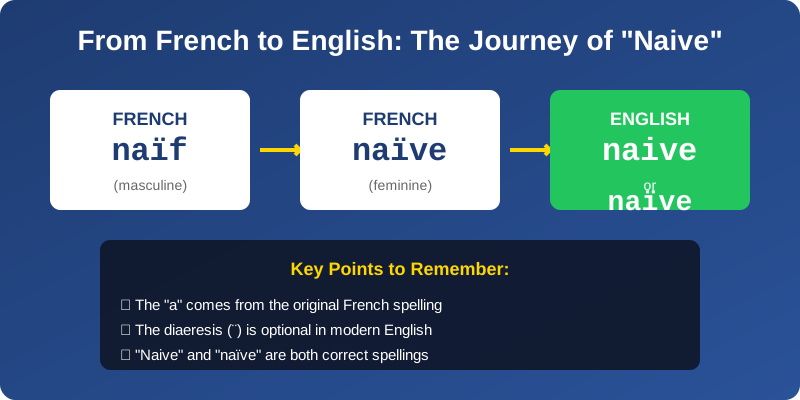
The French Connection I Discovered
The word naive comes from the French word naïf (masculine) or naïve (feminine). When English borrowed this word, we kept the 'a' from the original French spelling. The diaeresis (the two dots over the ï) is optional in modern English, which is why you'll see both naive and naïve.
That's why the correct spelling is with an 'a' - it preserves the original French pronunciation and spelling pattern.
My Definition and Meaning Analysis
Naive is an adjective that describes someone who shows a lack of experience, wisdom, or judgment. I found it has several nuanced meanings depending on the context:
1. Lacking Experience
Someone who is inexperienced or unsophisticated, especially in a particular area.
"I was naive about how the business world worked when I first started."
2. Too Trusting
Someone who believes things too easily and doesn't question enough.
"She's naive to think everyone always tells the truth."
3. Innocent or Unaffected
Someone who is simple, genuine, and unaffected by worldly concerns.
"His naive charm won everyone over immediately."
4. Unsuspecting
Someone who doesn't realize there's a problem or danger.
"They were naive about the risks involved in the investment."
Naive vs Nieve: My Comparison Table
I created this detailed comparison to help you understand the difference:
| Word | Status | My Explanation |
|---|---|---|
| Naive | Correct | Standard English spelling from French "naïf/naïve" |
| Naïve | Correct | Alternative correct spelling with diaeresis (optional) |
| Nieve | Incorrect | A common misspelling - not a valid English word |
Examples I Use in Different Contexts
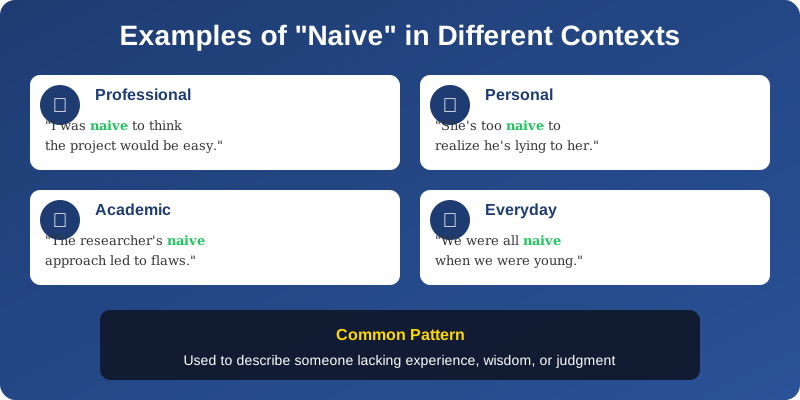
Professional Context:
- ✓ "I was naive to think the project would be easy."
- ✓ "Don't be naive about market competition."
Personal Context:
- ✓ "She's too naive to realize he's lying to her."
- ✓ "We were all naive when we were young."
Academic Context:
- ✓ "The researcher's naive approach led to flawed conclusions."
- ✓ "A naive interpretation of the data misses important nuances."
Incorrect Examples (What NOT to Write):
- ✗ She was nieve about the risks.
- ✗ Don't be so nieve.
Common Related Words I Found
I discovered that "naive" has several related forms you should know:
| Word | Part of Speech | Meaning |
|---|---|---|
| Naive | Adjective | Lacking experience or judgment |
| Naively | Adverb | In a naive manner |
| Naivety | Noun | Quality of being naive (British spelling) |
| Naiveté | Noun | Quality of being naive (French-inspired spelling) |
Usage Examples of Related Words
Adverb: "I naively believed the advertisement."
Noun (British): "Her naivety was charming at first."
Noun (French-style): "His naiveté about politics was obvious."
Why People Make the "Nieve" Mistake
I found several reasons why people incorrectly spell it as "nieve":
- Phonetic Confusion: In some accents, "naive" can sound like it might have an "ie" or "i" sound
- Spanish Influence: "Nieve" means "snow" in Spanish, which might confuse Spanish speakers learning English
- Visual Pattern: Many English words use "ieve" patterns (believe, relieve, retrieve), leading to overgeneralization
- Lack of Exposure: Some people simply haven't seen the correct spelling enough times to remember it
Memory Tip I Use
I remember the correct spelling by thinking: "NAIVE has A Vowel In Essential position" - helping me recall there's an 'a' not an 'ie' in the first syllable.
Or simpler: "Naive is from French - French words often keep their original spelling"
Naive in Different Fields
I found that "naive" has special meanings in specific professional contexts:
Computer Science
A "naive" algorithm or approach is the simplest, most straightforward solution (often inefficient).
"The naive approach has O(n²) complexity, but we can optimize it."
Mathematics
"Naive set theory" refers to intuitive, non-axiomatic approaches to mathematical sets.
"We'll start with naive set theory before introducing axioms."
Psychology
Describes cognitive simplicity or lack of critical thinking in certain situations.
"Naive realism is the belief that we see the world exactly as it is."
Art/Literature
"Naive art" refers to works created by artists without formal training.
"Grandma Moses is famous for her naive painting style."
Formal vs Informal Usage
I noticed that "naive" works well in both formal and informal contexts:
| Context | Example Usage |
|---|---|
| Academic Writing | "The naive assumption that correlation equals causation..." |
| Business Communication | "We were naive about our competitor's response." |
| Casual Conversation | "That's a pretty naive way to look at it." |
| Journalism | "Critics argue the policy is naive about economic realities." |
Explore More Grammar Guides
If you found this analysis helpful, I have created other detailed guides to help you master English spelling and grammar:
- 👉 Puting or Putting: The Complete Guide
Learn the CVC rule and when to double consonants.
- 👉 To Bad or Too Bad?
Discover why "too bad" is the only correct spelling.
- 👉 Unphased or Unfazed?
Learn the correct spelling and the faze vs phase confusion.
- 👉 Vender or Vendor?
Discover why "vendor" is the correct spelling.
- 👉 Is Good Morning One Word?
Learn greeting grammar rules and spacing.
- 👉 Time Flies or Time Flys?
Master third-person singular spelling rules.
Frequently Asked Questions
Is it naive or nieve?
The correct spelling is 'naive' with an 'a'. 'Nieve' is an incorrect spelling and should be avoided in formal writing. The word comes from French 'naïf/naïve', which explains the 'a' in the spelling.
Why is naive spelled with an a?
The word 'naive' comes from the French word 'naïf'. The spelling preserves the original French 'a' from the root word. The diaeresis (two dots) over the ï is optional in English, so both 'naive' and 'naïve' are acceptable spellings.
What does naive mean?
Naive means showing a lack of experience, wisdom, or judgment. It describes someone who is innocent, unsophisticated, or too trusting. For example: 'She was naive to believe everything she read online.'
Can you spell it naive or naïve?
Both spellings are correct! 'Naive' (without the diaeresis) is more common in modern English, especially online. 'Naïve' (with the diaeresis marks) preserves the original French pronunciation guide and is also perfectly correct. Both forms are accepted in all English-speaking countries.
Is nieve a word in English?
No, 'nieve' is not a valid English word when trying to spell 'naive'. However, 'nieve' is a valid Spanish word meaning 'snow'. This Spanish connection sometimes causes confusion for Spanish speakers learning English.
What's the difference between naive and innocent?
While similar, 'innocent' generally refers to being free from guilt or wrongdoing, while 'naive' refers specifically to a lack of experience or judgment. Someone can be innocent without being naive, and vice versa. For example, a child might be both innocent and naive, but an adult could be naive about a specific topic while still being innocent of any wrongdoing.
How do you use naive in a sentence?
Here are examples: 'I was naive to think it would be easy,' 'Don't be naive about the risks,' or 'Her naive optimism was refreshing.' The word is typically used as an adjective describing someone or something that lacks experience, sophistication, or critical judgment.
Is naive an insult?
It can be, but not always. 'Naive' is descriptive rather than inherently insulting. In some contexts, it might be used patronizingly to suggest someone is foolishly trusting or inexperienced. However, it can also be used positively to describe someone's refreshing simplicity or lack of cynicism. Context matters greatly in determining whether it's meant negatively.
What part of speech is naive?
'Naive' is an adjective - it describes nouns. Related forms include 'naively' (adverb) and 'naivety/naiveté' (noun). For example: 'She was naive (adjective),' 'She naively believed (adverb),' 'Her naivety showed (noun).'
Why do people spell it nieve?
Common reasons include phonetic confusion (it sounds like it could have 'ie'), Spanish language interference ('nieve' means snow in Spanish), and overgeneralization of English spelling patterns like 'believe' or 'retrieve'. However, none of these make 'nieve' a correct spelling for the English word meaning inexperienced or unsophisticated.