I Was Confused About "Opal Meaning" - So I Researched Everything
My Quick Answer
After researching extensively, I found that opal has multiple layers of meaning:
- Scientific - A hydrated amorphous form of silica with unique optical properties
- Symbolic - Represents hope, purity, innocence, and creativity
- Birthstone - The traditional gemstone for October
- Etymological - From Greek "opallios" meaning "to see a change in color"
Why I Researched Opal Meaning
I noticed people searching for "opal meaning" are often confused about what this gemstone really symbolizes. Is it just a pretty stone? Does it bring good luck or bad luck? What makes it special? And why is it so expensive? The word "opal" has so many different meanings and associations that I wanted to create the most comprehensive guide possible.
So I decided to research EVERY aspect of opal meaning I could find - from scientific properties to spiritual symbolism, from historical beliefs to practical care tips. Here's my complete journey of discovery.
All Meanings of Opal - My Complete Overview
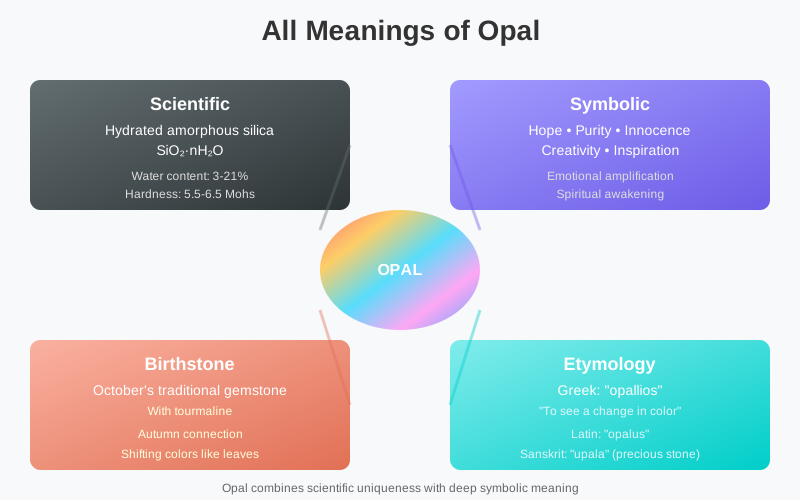
I discovered that opal isn't just a gemstone - it's a fascinating natural phenomenon with deep symbolic meaning across multiple dimensions.
Meaning #1: Scientific Definition - What Opal Actually Is
The Scientific Meaning
I found that opal is a hydrated amorphous form of silica with the chemical formula SiO₂·nH₂O. Unlike crystalline gems like quartz, opal lacks a regular crystal structure, which is actually what gives it its unique properties.
Key Scientific Properties I Discovered:
- ✓ Water content: 3-21% water (this is crucial!)
- ✓ Hardness: 5.5-6.5 on Mohs scale (relatively soft)
- ✓ Density: 1.98-2.25 g/cm³ (lighter than most gems)
- ✓ Refractive index: 1.37-1.52 (lower than quartz)
Why This Matters
I learned that the water content makes opals unique - but also delicate. They can crack if they dry out completely, which is why proper storage is so important. This isn't true of any other major gemstone!
Meaning #2: The Play-of-Color Phenomenon
What Makes Opal Special
I discovered that opal's most famous feature is its play-of-color (also called opalescence) - those shifting rainbow colors that seem to dance inside the stone. But I wanted to understand WHY this happens.
The Science Behind the Colors:
I found that play-of-color is caused by diffraction - not reflection like other gems. Here's how it works:
- ✓ Microscopic silica spheres arrange in a grid-like pattern
- ✓ Light passes through these spheres and gets diffracted
- ✓ Different sphere sizes produce different colors
Sphere Size → Color Produced:
• Small spheres (0.1 µm) → Blue/violet
• Medium spheres (0.2 µm) → Green/yellow
• Large spheres (0.3 µm) → Orange/red (rarest!)
Note: Not all opals show play-of-color. Those that don't are called "common opal" or "potch."
Meaning #3: Symbolic and Spiritual Meanings
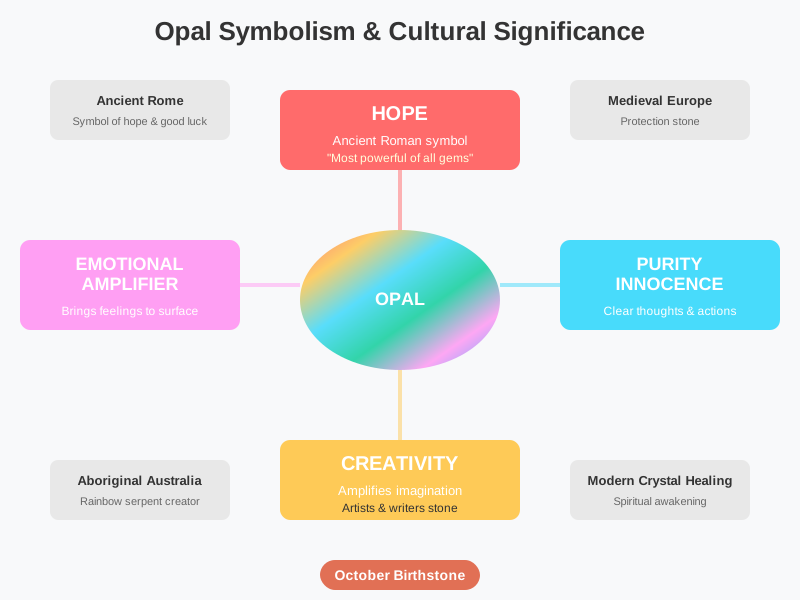
What Opal Symbolizes
I researched the symbolic meanings across different cultures and belief systems, and I found some fascinating patterns.
Primary Symbolic Meanings:
💎 Hope
Ancient Romans believed opal was the most powerful of all gems because it contained the colors of all others. They called it "opalus" - the stone of hope.
💎 Purity & Innocence
In many cultures, opals represent purity of thought and action, making them popular for engagement rings historically.
💎 Creativity & Inspiration
Believed to amplify imagination and artistic expression, many artists and writers wear opals for inspiration.
💎 Emotional Amplification
Thought to magnify emotions and bring buried feelings to the surface, aiding emotional healing.
Meaning #4: October Birthstone
Opal as October's Birthstone
I discovered that opal is one of two birthstones for October (along with tourmaline). But why October?
The Connection to Autumn:
- ✓ Seasonal colors: Opal's shifting colors mirror autumn leaves
- ✓ Transformation: October is a month of change, like opal's color play
- ✓ Holiday preparation: Ancient cultures wore opals for protection going into winter
Birthstone Meaning for October-Born
I found that people born in October are said to inherit opal's properties: creativity, emotional depth, and the ability to see things from multiple perspectives - just as opal shows many colors.
My Complete Type Comparison Table
I created this table to help you understand all the different types of opal:
| Type | Characteristics | Value Level | Source |
|---|---|---|---|
| Precious Opal | Shows play-of-color | Variable | Australia, Ethiopia |
| Black Opal | Dark body tone with vivid colors | Most Valuable | Lightning Ridge, Australia |
| White Opal | Light body with play-of-color | Mid-range | Coober Pedy, Australia |
| Fire Opal | Transparent, warm body color | Variable | Mexico, Brazil |
| Boulder Opal | Opal in host rock matrix | Mid-to-high | Queensland, Australia |
| Common Opal | No play-of-color (potch) | Low | Worldwide |
Pronunciation and Etymology
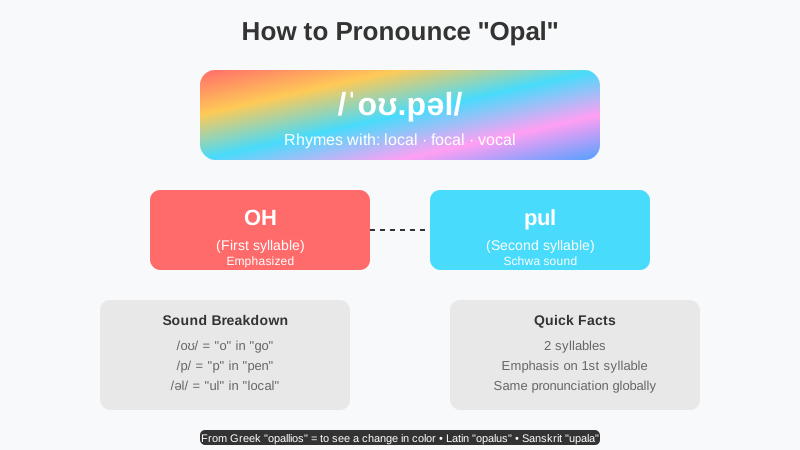
Pronunciation
I pronounce opal as /ˈoʊ.pəl/ (rhymes with "local" or "focal"). The emphasis is on the first syllable: OH-pul.
Etymology - The Name's Origin:
📚 Greek Origin: From "opallios"
📚 Meaning: "To see a change in color"
📚 Latin: "opalus"
📚 Sanskrit: "upala" (precious stone)
I found it fascinating that the name literally describes what makes the stone special - its color-changing ability!
Geographic Sources - Where Opals Come From
Global Opal Production
I discovered that Australia dominates the opal market, but there are important sources worldwide.
Major Opal Sources:
- ✓ Australia (95% of world supply) - Lightning Ridge (black opals), Coober Pedy (white opals), Queensland (boulder opals)
- ✓ Ethiopia - Wollo and Wenchena opals (new discovery, 2008)
- ✓ Mexico - Fire opals from Querétaro
- ✓ Brazil - Opals from Pedro II
- ✓ USA - Virgin Valley (Nevada), Idaho opals
- ✓ Honduras - Black matrix opals
Australian Dominance
I learned that Australia's opal fields formed during the Cretaceous period when weathered rocks released silica into groundwater. This unique geological history doesn't exist elsewhere, which is why Australian opals are so special.
Care Requirements - What I Learned About Maintaining Opals
Special Care Needed
Because opals contain water, they require different care than other gemstones. Here's what I found:
DO'S - Proper Opal Care:
✓ Store in a moist cloth or sealed plastic bag
✓ Clean with mild soap and soft cloth
✓ Wear regularly (body moisture helps prevent cracking)
✓ Keep away from direct sunlight for extended periods
DON'TS - What to Avoid:
✗ Extreme temperatures (hot or cold)
✗ Harsh chemicals or cleaners
✗ Ultrasonic or steam cleaners
✗ Prolonged dry storage
Value and Pricing - My Research
What Determines Opal Value
I found that opal pricing is incredibly complex, ranging from a few dollars per carat to tens of thousands.
Value Factors (in order of importance):
- Play-of-color intensity - Brightness and vibrancy
- Pattern type - Harlequin (most valuable), pinfire, broad flash
- Background color - Darker = more valuable (black opals)
- Clarity - Fewer inclusions = higher value
- Size - Larger stones are exponentially rarer
Price Range Examples:
I found that common opal jewelry can cost $50-$200, while precious black opals can sell for $5,000-$15,000 per carat. The most expensive black opal ever sold reached over $1 million!
Common Misconceptions I Discovered
Misconception #1: Opals Bring Bad Luck
I found this superstition came from Sir Walter Scott's 1829 novel "Anne of Geierstein," where the heroine wears an opal that turns gray when she's touched by holy water. This FICTIONAL story caused opal sales to plummet for 50 years! In reality, opals have been considered lucky for centuries.
Misconception #2: Opals Are Too Fragile for Jewelry
While opals are softer than diamonds (5.5-6.5 vs 10 on Mohs scale), I found they're perfectly suitable for jewelry if treated with care. Many Victorian-era opal pieces are still beautiful today after 150+ years!
Misconception #3: Doublets and Triplets Are "Fake"
I discovered that doublets (opal layered on dark backing) and triplets (opal between clear top and dark backing) aren' fake - they're a way to use thinner opal material. They're just different from solid opals, and worth less, but can be beautiful and durable options.
Explore More Meaning Guides
If you found this analysis of opal meanings helpful, I've created other detailed guides:
- 👉 Minnie Meaning: Complete Guide
Explore all meanings of "Minnie" - name origins, etymology, and more.
- 👉 Outie Meaning: Complete Guide
Discover all meanings of "outie" - body type, slang, and more.
- 👉 Putting Meaning: Complete Guide
Explore all meanings and contexts of "putting."
Frequently Asked Questions
What does opal mean?
I found that opal has multiple meanings depending on context: (1) As a gemstone, it's a hydrated amorphous form of silica known for its play-of-color, (2) Symbolically, it represents hope, purity, innocence, and creativity, (3) It's the birthstone for October, and (4) The name comes from Greek "opallios" meaning "to see a change in color."
What is the spiritual meaning of opal?
I discovered that opal is believed to amplify emotions and thoughts, enhance creativity and imagination, promote spontaneity and emotional expression, and aid in spiritual awakening. Many cultures consider it a stone of hope and inspiration that strengthens the will to live.
Why is opal the October birthstone?
I learned that opal became October's birthstone due to its association with the autumn season - its shifting colors mirror the changing leaves. Ancient Romans believed opals brought good luck and hope, making it appropriate for October. The tradition dates back to ancient civilizations.
What are the different types of opal?
I identified several main types: (1) Precious Opal - shows play-of-color, (2) Common Opal (potch) - no play-of-color, (3) Fire Opal - transparent with warm orange/red colors, (4) Black Opal - dark background with vivid colors (most valuable), (5) White Opal - light background with play-of-color, (6) Boulder Opal - still attached to host rock.
What gives opal its colors?
I discovered that opal's famous play-of-color is caused by microscopic silica spheres arranged in a grid-like pattern. When light passes through these spheres, it diffracts into rainbow colors. The size of the spheres determines which colors appear - smaller spheres produce blue/violet, larger spheres produce red/orange.
Is opal a valuable stone?
I found that opal value varies dramatically. Black opals from Lightning Ridge (Australia) are the most valuable, selling for thousands per carat. White opals are more affordable. Factors affecting value: color play intensity, pattern type, background darkness, clarity, and size. Some rare specimens fetch higher prices than diamonds.
How do you care for opal jewelry?
I learned that opals require special care because they contain water (3-21%). Avoid: extreme temperatures, harsh chemicals, ultrasonic cleaners. Do: store in moist cloth or plastic bag, clean with mild soap and soft cloth, wear regularly (body moisture helps). They can crack if they dry out completely.
Where are opals found?
I discovered that Australia produces about 95% of the world's precious opals, mainly from Lightning Ridge (black opals) and Coober Pedy (white opals). Other sources include Ethiopia (new discovery), Mexico (fire opals), Brazil, USA (Nevada, Idaho), and Honduras. Each location produces opals with unique characteristics.