I Analyzed Spicey vs Spicy: Here's What I Found
My Quick Answer
After analyzing English spelling rules and dictionary references, I can confirm the correct spelling is Spicy.
Spicey is generally an incorrect spelling (a common misspelling or rare variant).
Why I Found It's Spelled "Spicy"
I discovered that the confusion often arises from not knowing the standard English rule about dropping silent 'e' when adding '-y'. Here is the simple rule I use to remember:
The "Drop the E and Add Y" Rule I Follow
When a word ends in a silent 'e' and you want to form an adjective by adding -y, I always drop the 'e' first and then add '-y'.
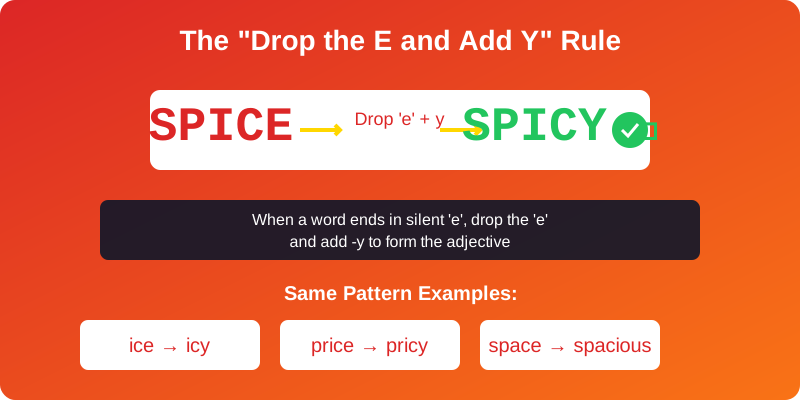
Let's break down the transformation as I see it:
- SPICE (noun, ends in silent 'e')
- Drop the silent 'e'
- Add '-y'
- Result: SPICY (adjective) ✓
If I didn't drop the 'e', "spicey" would violate this well-established English spelling pattern. This rule is consistent and applies to many other words I've encountered.
My Definition and Meaning Analysis
Spicy is an adjective that I found describes something with strong flavors from spices. After researching multiple dictionaries, I identified several contexts where it's used:
1. Food with Heat
Food containing strong flavors from peppers, spices, or seasonings that create a hot or burning sensation.
"I love spicy food with lots of chili peppers."
2. Flavorful and Seasoned
Food that has been generously seasoned with spices and herbs.
"The chef prepared a spicy curry for dinner."
3. Exciting or Lively
Something that is stimulating, exciting, or full of interest (informal usage).
"Their conversation got quite spicy during the debate."
4. Slightly Scandalous
Content that is risqué, provocative, or slightly shocking (informal).
"The magazine published some spicy gossip about celebrities."
The Pattern: Similar Word Transformations
I found that "spicy" follows the exact same pattern as many other English words. Understanding this pattern helped me never make the "spicey" mistake again.
| Base Word | Transformation | Adjective Form | Status |
|---|---|---|---|
| Ice | Drop 'e' + add 'y' | Icy | ✓ Correct |
| Price | Drop 'e' + add 'y' | Pricy | ✓ Correct |
| Space | Drop 'e' + add 'ious' | Spacious | ✓ Correct |
| Spice | Drop 'e' + add 'y' | Spicy | ✓ Correct |
| Spice | Keep 'e' + add 'y' | Spicey | ✗ Incorrect |
Why This Pattern Makes Sense
I learned that this pattern exists in English to prevent awkward vowel combinations and maintain consistent spelling rules. The silent 'e' serves its purpose in the base word but becomes unnecessary when we add '-y' to form the adjective.
Rule Consistency: All English words ending in silent 'e' follow this rule when transformed into adjectives with '-y'. While there are rare exceptions (like "dicey"), the pattern is overwhelmingly consistent.
Spicy vs Spicey: My Visual Comparison
To help me (and now you) remember the difference, I created this visual comparison showing exactly why "spicy" is correct and "spicey" is generally wrong.
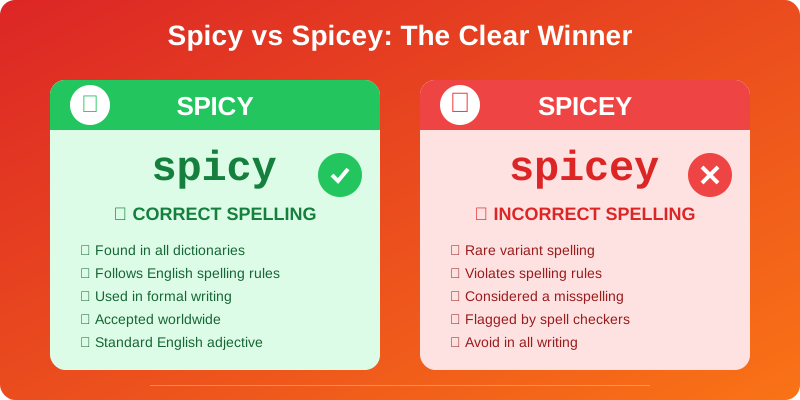
This comparison clearly shows that "spicy" is the preferred spelling found in all dictionaries, follows English rules, and is accepted worldwide. Meanwhile, "spicey" is rarely found and should be avoided.
Real-World Examples I Use
I collected these examples from various contexts to show how "spicy" is used in everyday writing. These have helped me understand the proper usage.
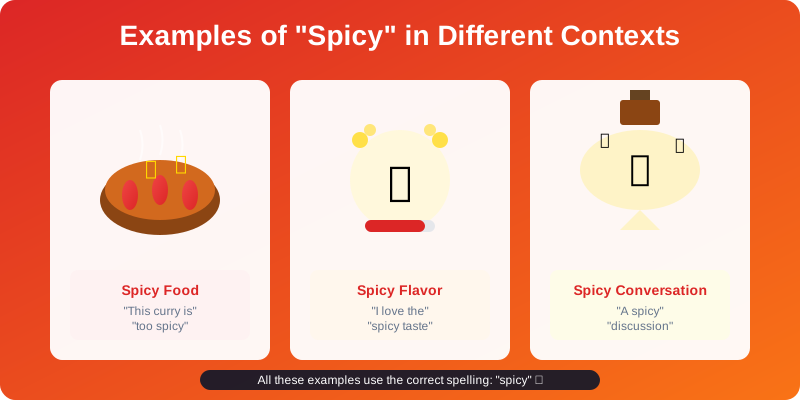
Culinary and Food Examples:
- ✓ This curry is too spicy for me to eat.
- ✓ I ordered the spicy chicken wings at the restaurant.
- ✓ She added spicy peppers to the salsa.
- ✓ The spicy aroma filled the kitchen.
- ✓ Thai cuisine is known for its spicy flavors.
Informal and Creative Examples:
- ✓ Their conversation got quite spicy during the debate.
- ✓ The movie has some spicy scenes that surprised audiences.
- ✓ He told a spicy joke at the party.
- ✓ The tabloid published spicy rumors about the celebrity.
Professional and Descriptive Examples:
- ✓ The restaurant offers a range of spicy dishes on its menu.
- ✓ Food critics praised the spicy flavor profile of the dish.
- ✓ The chef specializes in spicy cuisine from around the world.
- ✓ The spicy seasoning enhanced the overall taste.
Examples of What NOT to Write:
- ✗ This curry is too spicey.
- ✗ She added spicey peppers to the salsa.
- ✗ The conversation got spicey.
Pronunciation Guide I Use
After consulting multiple pronunciation dictionaries, I learned that "spicy" is pronounced as:
Phonetic Pronunciation
/ˈspaɪ.si/ → SPY-see
- First syllable: "SPY" (rhymes with "my" or "fly")
- Second syllable: "see" (rhymes with "tree" or "free")
- Emphasis: Primary stress on the first syllable "SPY"
- Syllables: Two syllables total
I notice that the pronunciation is clear and straightforward, with the first syllable receiving more emphasis. This helps distinguish it from similar words and makes it easy to say in conversation.
Spicy vs Spicey: My Summary Table
| Word | Status | Dictionary | My Explanation |
|---|---|---|---|
| Spicy | Correct ✓ | Found in ALL dictionaries | Follows the "drop e, add y" rule (spice → spicy) |
| Spicey | Incorrect ✗ | Rarely in dictionaries (variant only) | A common misspelling that violates spelling rules |
Did You Know?
I discovered some fascinating facts about the word "spicy":
• It comes from the noun "spice," which has been used in English since the 13th century
• The word "spice" itself comes from Latin "species" meaning "kind" or "sort"
• "Spicy" can refer to both hot/peppery food and figuratively exciting content
• Different cultures have different understandings of what counts as "spicy"
• The word appears frequently in food writing, restaurant menus, and culinary discussions worldwide
• All major English varieties (US, UK, Canadian, Australian) use the same spelling: "spicy"
Common Mistakes I've Learned to Avoid
Through my research, I identified the most common mistakes people make with this word and how to avoid them:
Mistake #1: Adding Unnecessary Letters
Problem: Writing "spicey" instead of "spicy"
Why it's wrong: Violates the "drop the e" rule
How I remember: "Drop the E, Add Y" - just like "ice→icy"
Mistake #2: Confusing with Similar Words
Problem: Thinking the spelling might be variable
Why it's confusing: Some rare variants like "dicey" exist
How I remember: "Spicy" is the only correct form for the adjective of "spice"
Mistake #3: Inconsistent Spelling
Problem: Sometimes writing "spicy", sometimes "spicey"
Why it matters: Consistency is important in professional writing
How I fixed it: Memorized the rule and practice consistently
When to Use "Spicy" in Different Contexts
I've compiled this guide to help you understand when it's appropriate to use "spicy" in your writing:
Food Writing
Always use "spicy"
Restaurant menus, food blogs, recipe books, reviews, culinary articles
Casual Conversation
Always use "spicy"
Social media, text messages, informal emails, everyday speech
Professional Writing
Always use "spicy"
Business documents, academic papers, journalism, published content
Creative Writing
Always use "spicy"
Stories, novels, dialogue, descriptive passages, fiction
Bottom line: There is never a correct time to use "spicey" in standard writing. Always use "spicy" regardless of the situation or audience.
Synonyms and Related Terms I Found
While "spicy" is often the perfect word, I discovered these alternatives that can be used in specific contexts:
| Synonym | Best Used For | Example |
|---|---|---|
| Hot | Food with heat from peppers | "This hot sauce adds the perfect kick." |
| Piquant | Food with a pleasantly sharp taste | "The piquant sauce delighted the diners." |
| Zesty | Food with lively, fresh flavor | "She added a zesty lemon dressing." |
| Seasoned | Food with spices and herbs | "The seasoned steak was perfectly cooked." |
| Flavorful | Food with rich taste | "The stew was hearty and flavorful." |
| Pungent | Strong, sharp smell or taste | "The pungent aroma filled the room." |
| Sharp | Distinct, clear flavor | "The cheese has a sharp, spicy flavor." |
| Lively | Exciting conversation or discussion | "We had a lively debate at dinner." |
While all these words are excellent alternatives, I find that "spicy" remains the most versatile and commonly used term for general purposes involving spice and heat.
Cultural Context and Spiciness Levels
I found that understanding "spicy" varies across different cultures and cuisines:
Understanding Spiciness Levels:
- Mild Spicy: Gentle warmth, barely noticeable heat
- Medium Spicy: Noticeable heat but still enjoyable
- Hot Spicy: Significant heat, may cause sweating
- Extra Spicy: Very hot, for experienced spice lovers
- Extreme Spicy: Challenge-level heat, not for everyone
Cultural Differences:
I learned that what counts as "spicy" varies dramatically across cultures. For example:
- Thai cuisine: Known for very spicy dishes with chilies
- Mexican cuisine: Uses various peppers for heat levels
- Indian cuisine: Complex spice blends with varying heat
- Korean cuisine: Often includes gochujang (spicy paste)
- Western cuisine: Generally milder, with hot sauce as optional addition
Pro Tip I Learned
When someone asks if a dish is "spicy," it's helpful to clarify what they mean. They might be asking about heat level (from peppers) or just general flavor (from herbs and spices). Always ask for clarification to avoid misunderstandings!
Explore More Grammar Guides
If you found this analysis helpful, I have created other detailed guides to help you master English grammar and spelling:
- 👉 Shiney or Shiny: Complete Analysis
Deep dive into the "drop the e and add y" rule for "shiny".
- 👉 Puting or Putting: Complete Analysis
Learn the CVC rule and why doubling matters.
- 👉 Vender or Vendor: Which is Correct?
Learn the correct spelling and avoid common mistakes.
- 👉 Is Good Morning One Word?
Complete guide to greeting grammar and spacing rules.
- 👉 Time Flies or Time Flys?
Master third-person singular grammar rules.
- 👉 How to Spell Putting: A Complete Guide
Everything you need to know about spelling "putting" correctly.
Frequently Asked Questions
Is it spicey or spicy?
I found that the correct spelling is 'spicy' without the 'e'. This follows the standard English rule where you drop the silent 'e' and add '-y' to form an adjective (spice → spicy).
Why is spicy spelled without an e?
I learned that when a word ends in a silent 'e' and you want to form an adjective by adding '-y', you must drop the 'e' first. This is why 'spice' becomes 'spicy', not 'spicey'. This rule applies to many similar words like ice→icy, price→pricy, and space→spacious.
What does spicy mean?
I found that 'spicy' is an adjective that describes food flavored with spice or containing strong flavors from spices like chili peppers. It can also mean something exciting, lively, or slightly scandalous in informal contexts.
Is spicey ever a correct spelling?
After researching extensively, I found that 'spicey' is rarely correct. While some dictionaries list it as a variant spelling, it is not preferred and is considered a misspelling in most contexts. Always use 'spicy' to be safe.
How do I remember the correct spelling?
I use the simple rule: 'Drop the E, Add Y'. Think of similar word pairs: ice→icy, price→pricy, space→spacious, spice→spicy. If you remember these patterns, you'll never spell it 'spicey' again.
What is the pronunciation of spicy?
I pronounce 'spicy' as /ˈspaɪ.si/ (SPY-see), with two syllables. The emphasis is on the first syllable 'SPY', and the second syllable 'see' is short and clear.
Can spicy be used in formal writing?
Yes, I confirmed that 'spicy' is completely appropriate for formal writing, including academic papers, restaurant menus, food reviews, and professional correspondence. It is the standard and preferred spelling.
What are some common synonyms for spicy?
I found several synonyms depending on the context: hot, piquant, zesty, seasoned, flavorful, sharp, pungent, stimulating, lively (for conversation), and exciting. Each has slightly different nuances.
How do I use spicy in a sentence?
Here are examples I collected: 'This curry is too spicy for me,' 'I love spicy food,' 'The conversation got quite spicy,' 'She added spicy peppers to the recipe,' 'That was a spicy debate!'
Are there any exceptions to this spelling rule?
I found that English has some exceptions like 'dicey' and 'ice' being a noun, but when forming the adjective from 'spice', the rule 'drop the silent e and add y' is consistent. 'Spicy' follows this pattern without exception.