What Type of Verb is "Put"?
Understanding the verb "put" is essential for mastering English grammar. Let's break down exactly what type of verb it is and how to use it correctly.
Put is an Irregular Verb
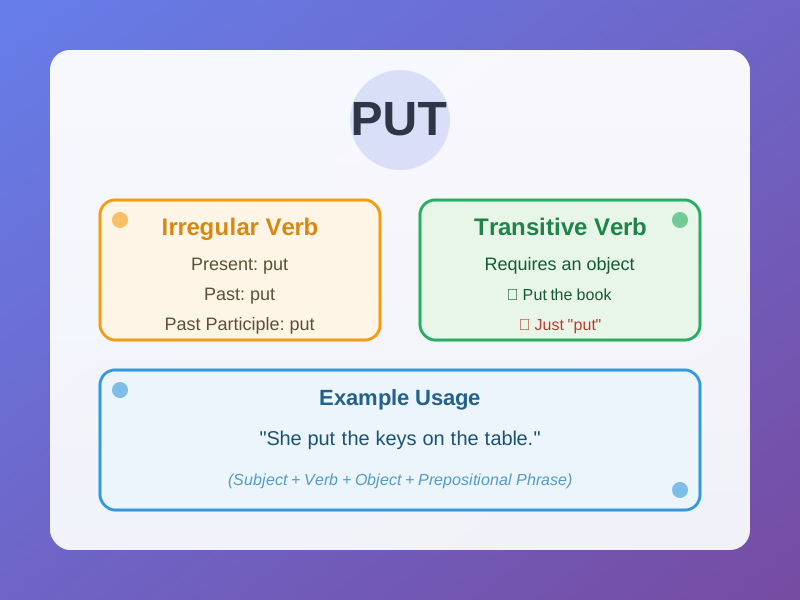
First and foremost, "put" is an irregular verb. Unlike regular verbs that follow the standard pattern of adding "-ed" for past tense (like "walk" → "walked"), "put" stays the same across all its forms.
Verb Forms of "Put"
- Base Form: put
- Past Simple: put
- Past Participle: put
- Present Participle: putting
- Third Person Singular: puts
This makes "put" one of those tricky verbs where you need to rely on context to understand the tense. For example:
- Present: "I put my keys on the table every day."
- Past: "Yesterday, I put my keys on the table."
- Present Perfect: "I have put my keys on the table."
Put is a Transitive Verb
The second crucial characteristic is that "put" is a transitive verb. This means it requires a direct object to make sense. You can't just "put" - you must put something.
✓ Correct Usage
"She put the book on the shelf."
(Object: the book)
✗ Incorrect Usage
"She put on the shelf."
(Missing object!)
Put Often Requires a Prepositional Phrase
Beyond just having an object, "put" typically needs a prepositional phrase to indicate where or in what state something is being placed.
The most common pattern is: Subject + put + Object + Prepositional Phrase
- "I put the flowers in the vase."
- "He put his phone on silent mode."
- "They put the blame on me."
- "She put her trust in her team."
Common Uses and Meanings of "Put"
While "put" is fundamentally about placement, it has many idiomatic uses in English:
Physical Placement
"Put the groceries in the fridge."
Expressing Ideas
"Let me put it this way..."
Causing a State
"The news put me in a good mood."
Investing Effort
"She put a lot of work into it."
Writing/Recording
"Put your name on the list."
Estimating
"I'd put his age at around 40."
Common Phrasal Verbs with "Put"
"Put" forms numerous phrasal verbs, each with distinct meanings:
- Put off: postpone ("Don't put off until tomorrow...")
- Put on: wear or gain ("Put on your coat" / "He's put on weight")
- Put up with: tolerate ("I can't put up with this noise")
- Put down: criticize or write ("Don't put yourself down")
- Put away: store ("Put away your toys")
- Put forward: propose ("She put forward a great idea")
- Put out: extinguish or inconvenience ("Put out the fire")
Is "Put" an Action Verb?
Yes! "Put" is definitely an action verb (also called a dynamic verb). It describes a physical or mental action rather than a state of being. Even in abstract uses like "put your mind to it," there's an implied action.
Common Mistakes to Avoid
Watch Out For:
- Spelling "putting" wrong: Remember to double the "t" - it's "putting," not "puting."Learn more about spelling "putting" →
- Using "put" without an object: Always include what you're putting.
- Forgetting the location: Usually you need to say where you're putting something.
- Confusing tenses: "Put" looks the same in present and past, so pay attention to context.
Quick Reference Summary
What Type of Verb is "Put"?
- ✓ Irregular verb (put, put, put)
- ✓ Transitive verb (requires an object)
- ✓ Action verb (describes an action)
- ✓ Usually requires a prepositional phrase
- ✓ Forms many phrasal verbs
Practice Examples
Here are some sentences to help you understand "put" in context:
- "Can you put the kettle on?" (turn on/start)
- "I put my faith in you." (place trust)
- "They put the meeting off until next week." (postponed)
- "He puts in long hours at work." (invests time)
- "She put her thoughts into words beautifully." (expressed)
- "The teacher put the question to the class." (asked)
Related Grammar Topics
If you're interested in learning more about verb types and grammar, check out these related topics:
Understanding that "put" is an irregular, transitive action verb will help you use it correctly in all contexts. Remember: you always put something somewhere!